My thoughts, reflections and inspirations within the world of design...

Tuesday, 24 May 2011


http://housedesigngallery.com/luxury-mansion/contemporary-luxuries-modern-house-design-by-agraz-arquitectos/

This really caught my eye as a piece of contemporary, stylish, light and spacious architecture. The interior carries on this feel, with the use of wood and neutral colours creating a relaxed and clean look.

The link above takes you to the House Design Gallery for the full article by Andre Ivano.

Tuesday, 19 April 2011

The Lake District stone


Whilst having a break in the Lake District a few weeks ago, I was interested by the traditional stone work used in the construction of the buildings around the National Park. The craftsmanship on the buildings, both old and new, is so intricate and detailed, and the result is buildings which fit in perfectly with the beautiful surrounding scenery, whilst still being outstanding to look at themselves.


Beside our hotel there was a building being constructed, and (presumably to save time and money) the building was being clad with around 5 inches of stone. In a nearby village we travelled through, rows of shops had been rebuilt, but again clad with the same traditional stone to maintain the traditional look on the facade of a contemporary building.


Wednesday, 30 March 2011

BOMB Project (2)


Over the last 3 days we have been doing a bomb project with Pete Morris from Curl la Tourelle Architects in London.

Our brief was to design something which brought the smartphone into the community and enabled people to connect and interact through it.

Myself, Caroline Martin and Charles Stewart teamed up, and looked into the different apps which were available in four different categories: social networking, music, games and photos. We chose to focus on social networking and music, and looking at a way to create an app which integrated both. We felt that it would be good to connect people through their similar tastes in music, so we created 'iRequest'.


iRequest is a smartphone app which involves the user requesting their favourite songs from the DJ's playlist before entering or whilst in a club, they are then sent directly to the DJs database, and come up in an order of which songs are requested the most. (i.e. if one song is requested 10 times, it will be above a song which is requested 7).


When the requested song is about to be played, the user receives a message informing them of this and can make their way to the VIP pod, a special area designed with surrounding LED screens which show a club scene with people dancing to the rhythm of the song. In the pod they can then meet and dance with other people who have requested the same song, therefore joining together people with similar music tastes.


Wednesday, 23 March 2011

Trekabout Progress - Group 2 Meeting Agendas

23.02.2011

On my return from a study trip in Magdeburg, we had a group meeting to further discuss our business proposal. Whilst me and Emilie were away, the rest of the group had changed the idea of our business, and had decided to make a website which would be targeting hillwalkers. It would give them the opportunity to book their hillwalking experiences online, all at once. After explaining this to us, we went on to allocate each person an area to research. Me and Emilie together were to look at the different places to go hillwalking in Scotland, and the accommodation available in each of the areas. We found around five walks for each area and some accommodation to go with them, which ranged from self catering to hotels. I feel that splitting the responsibilities up and giving everyone something to focus on ensured that we moved on quickly with our project without confusions.

24.02.2011

During this meeting we gathered everyone's research together and started to plan the presentation we were going to give. We looked into creating a website for our business and started to think of names for it, as well as different ways we could advertise and make money.

04.03.2011

In this meeting we started to create our presentation. We started to think about how to create the website, and allocated further jobs to everyone. We also started to look into costing more, and tried to figure out what would be a reasonable price for companies to be charged for the use of our website (i.e. advertising on it).

08.03.2011

During this meeting we started to design the website properly, looking into what categories we would put on it (accommodation, walks (including areas to select), profiles, travel, hire equipment, and then the usual contact us, etc). We looked at company values and decided what these would then be (shown on a previous post).

11.03.2011

We looked up some facts and figures abut hillwalking, picking out the main points which would attract people to the activity even if they were new to it, such as the health benefits and weight loss, as well as the experience of the great outdoors. We also created a facebook page and a twitter account, to make our business easily accessible and to build up a greater client list, as they could find it or be recommended it through friends etc.

14.03.2011

We finalised our presentation in this meeting and the people who were speaking went through what they were going to say, to time it and make sure it didn't exceed the 10 minutes.

16.03.2011

This was when we presented our business proposal. It went pretty smoothly, and we managed to keep just inside the allocated time slot (10 minutes) at 9 minutes 58 seconds! We got asked a few questions about our business, but overall it went well.

After the presentation, we finalised our portfolio ready for handing in with our research, development and final idea for our business. It also included photos of us working, mind maps we had created during the thought process and then the various other elements needed including a three year costing plan for our business and our bibliography.

Tuesday, 22 March 2011

Trekabout


Throughout our meetings we have been developing our business proposal and have now created our business 'Trekabout'.

Trekabout is an interactive, online travel agency for hillwalkers of all abilities that promotes small businesses and nurtures the hill walking community. Customers can create a personal profile on Trekabout that gives others a sense of their abilities and acheivements as a hill walker. Our accessible website is a hub where hill walkers can arrange each part of their trip, from travel and accommodation, to borrowing equipment and recruiting friends to their walk. Personal profiles, forums and photography gallery will spur on new friendships and communications within the hillwalking community and give less competent walkers the chance to find experiences walkers to aid them on their journey.


We respect that the hill walking community are protective of the small businesses and accommodation they use on a regular basis, so Trekabout aims to promote these places and provide them with a regular business but only that are recommended, tries, tested and found to meet our high standards. We want these services to help themselves by helping us, by looking after their customers that will lead the way, rather than our own predictions. It encourages a post-consumerist outlook on life, where people can learn, at little cost, that great experiences can be uncovered right on their doorstep.

Friday, 11 March 2011

Group Meetings

During our meetings this week we have been planning the layout of our slideshow for the presentation, and we have discussed the accounting side of things and planned our costs and expenditure. We discussed some more about our website and the different pages and categories which will be on it.

We looked more at our values and finalised our values:
  • celebrating nature as a source of leisure and education
  • promoting existing mutual respect within the hillwalking community
  • supporting small businesses and towns/villages by drawing in new customers
  • encouraging respect, love and appreciation for the outdoors
  • always promoting fun, safety and respect within nature
  • supporting friendly communication and socialising within an open group where people are expected to help and be helped
  • helping a holisitic nature experience for beginners, experienced walkers, families and friends
  • personally experiencing walks, accommodation and travel options before recommending them to customers
We also created a facebook and twitter page, to promote our business over the internet more, and to bring together more like minded people.

Tuesday, 1 March 2011

Scandinavian Architecture


Private Summer House in Sweden, WRB Architects

Through our current studio project, Simulate Stimulate, I have been looking a lot into Norwegian and Scandinavian Architecture. The site I have chosen for my project is in Wormit, a small village in Fife near to Newport-on-Tay. The village has historical connections with Norway, as the Norwegian King (King Haakon VII) stayed in Wormit during World War II, and many Norwegian boats were docked at Wormit Harbour. The local Church of Scotland held services for Norwegian Soldiers during and after the war ended. The King's soldiers painted a mural on the walls of the house in which the King stayed, which is still there today. The Norwegian Flag is still flown in Wormit today.

Rock Blending Summer House in Vestfold, Norway. By Jarmund / Vigsnæs AS Architects MNAL


The traits of modern Scandinavian architecture are very appealing to me, with large areas of glass in most of the buildings, which creates a feeling of being close to the outdoors and the environment. The main material used in many of the designs I have looked at is wood, which creates a natural feel which blends into the natural surroundings of most of the buildings. As Norway is a very sparsely populated country, the space around the buildings is usually fairly large, which i feel is an important part of the success of the architecture. I have included a few photos of some of my favourite scandinavian designs.

Villa Storingavika in Norway, Saunders Architecture

The Edge House, Norway by Jarmund / Vigsnæs AS Architects MNAL

Friday, 25 February 2011

Business Proposal


For the next stage of our Design studies, we have been asked to create a business which would appeal to post-consumers, like the one we created for the previous assignment. Our idea was to create a website for hillwalkers, similar to a package holiday website. This website would provide the opportunity for walkers to search for a route, book accommodation and transport, hire equipment and get in touch with other walkers who are of the same experience as them who may want to join them. We found that although there was walking websites available, most of them only provided links to other websites for accommodation and transport, meaning the user would have to book everything separately. Our website would eliminate this and mean that booking a hillwalking trip would be much easier, quicker, and therefore stress-free.


Wednesday, 23 February 2011

GIDE 2011

Last week our course travelled to Magdeburg for the 2011 GIDE International event. A number of students from the seven participating countries (Scotland, England, Slovenia, Switzerland, Italy, Belgium and Germany) all attended, and we were put into groups with students from these countries.


Our group went to visit "Experimentelle Fabrik" in Magdeburg, which is a development and research centre which tests products for the 'CE' mark.

"The main project of the Experimental Factory integrates several individual projects which research the development, production, experiments and tests of new innovative products in the field of mechanical engineering. "


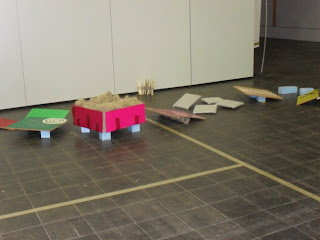
We were then asked to design and make a game. After mind mapping in our groups, we came to the idea of 'stepping stones'. We split into smaller groups and each created out own 'stepping stone', before linking them all together to create an obstacle course-like game.


The game was created to be played against another person, with each player having a 'jumping board', which they used to jump from one obstacle to another. At each obstacle the player had to complete the task, pick up a cube from the other end, and then go back through the obstacle before moving onto the next one. The player who collects all four cubes first wins.


Monday, 7 February 2011

Post Consumer Profile - Peter Smith

Our second assignment was to create a profile of a post consumer. To take a different view on this task, we decided to make a facebook profile of what we feel a post consumer would be like:

http://www.facebook.com/profile.php?id=100001952368482

Peter Smith is a middle aged man, who volunteers for charities like Oxfam. His interests include environmentally-friendly things such as hybrid cars, and he is also into locally produced food, and likes growing his own vegetables in an allotment. Peter enjoys outdoor activities such as hillwalking and cycling, which are not only good for the environment but they also keep him healthy.


Wednesday, 26 January 2011

Personality test

Individually, our group took part in the VARK personality questionnaire. I found that although the questions were good, some of them were vague, and on a number of occasions I found that my answer was not a straight forward agree or disagree, but that it would depend entirely on the situation. In some circumtances I would agree with the statement and others I wouldn't, it would depend on factors such as the project, the group I was working with and the part I was playing in the groupwork.

My results found that I was moderate in both activist and theorist, however after reading the information about each group, I felt that I was most strongly an activist. This was also what one of the members of my group which I have worked closely with and am friends with thought I was.

For the most part, our group found that quite a lot of the results to the test were a bit wrong and did not fall into the group that they thought they would. Our group found we have a fair mixture of people in different groups, with four activists, one theorist, two reflectors and one pragmatist. I feel that this works well in our group, as a mixture of all the personality groups should be.

Tuesday, 16 November 2010

Technology Addiction (2) GIDE


It was interesting to see that many people said they could live without technology, so we decided to create a timeline of all the major technological discoveries - this ranged from fire to the most recent developments such as 'facetime' on the new iPhone 4 this year.


We then created a wall of images of different types of technology (and not just the obvious things) and we ask again - can you really love without technology?


Thursday, 4 November 2010

Are we addicted to technology?


GIDE continued..

We are currently researching into Domestechtopia, and through this, technology addiction. Technology is becoming a more and more prominent part of our everyday lives, and many people will admit that they cannot live without it. Our generation has grown up with technology as part of life, and with more new technologies being discovered all the time, it is hard not to become caught up in it. But has it gone too far? Technology addiction is now being known as a real medical condition, especially in teenagers and young people, and therapy for this addiction is becoming more common. The Capio Nightingale Hospital in London was the first hospital to create a clinic to deal with the addiction of technology in young people. It admits mainly 15-7 year olds, but even children as young as 12 have been accepted. The clinic provides therapy for young people struggling with a continued addiction to technology. Patients are made to go 'cold turkey' from all technology, often causing symptoms typical of addiction, such as restlessness and stress. Individual and group sessions are in place to encourage them to interact with others and to address social issues that people with this addiction often face, like difficulties in social situations with other people.


We carried out a couple of surveys to see how addicted people around the art school were to technology, and what items they could not live without. The questionnaire results were interesting, with some people appearing very addicted to technology, and others not so much. Some students admitted to spending more time on social networking sites than with real people, and checked their emails "far too much", on excess of five times a day. Some pointed out that with the technology of smartphones, their emails get sent directly to their phone so are as available as a text message. Others said they could live without technology, although they wouldn't necessarily want to, and that their idea of utopia would not centre around technology. Some said they spent nothing on technology each month, whereas some said they spent on average of £50 - a lot of money for a student!!


We asked people to write down a piece of technology they could not live without, and the most popular results were laptops, hair straighteners, internet, iPod (or other music devices), and mobile phones - with iPhones appearing to be the most commonly mentioned, but there were many items of technology mentioned:


Whether iPhones seemed to be mentioned most could be for more than one reason: are they the most common type of mobile phone used these days, or are they simply more addictive than others, and people feel they cannot live without them due to the fact that they are useful for more than one thing - they have an integrated iPod, camera, text, phone, email account, internet, and thousands of apps to choose from.


The most visited sites seem to be Facebook and design sites (although the people who filled out the questionnaire were mainly design students), which poses another question - is the internet addictive, or are social networking sites?


Wednesday, 3 November 2010

Bomb Project

The problem is never how to get new, innovative thoughts into your mind, but how to get old ones out. Every mind is a building filled with archaic furniture. Clean out a corner of your mind and creativity will instantly fill it.’ Dee Hock


Over the last 3 days, all four years of IED have taken part in a group project called 'Bomb Project'. The idea was to create "a 3D reinterpretation, or a conceptual ‘portrait’ of a building typology." Each group was given a building typeology, either: care, learn, play, dwell or shop. Our group got dwell.

Through thinking about the word dwell and its meanings, the double meaning of the word was discovered. Dwell - a space or place, and dwell - to think, remember, ponder. Through this, the idea was to create a 'dwelling' in which to 'dwell'.


Our final design was a box which was covered in paper. The paper would be ripped down to release balloons into the air, which symbolised happy thoughts, and the escalation of them when a person's imagination and mind are left to wander.


The balloons had happy words on them, such as happiness, joy, glee and many more. In the centre of the box was a smaller carboard box, inside which was a single balloon with a question mark on it, asking the question: What is your happy thought?


Monday, 25 October 2010

GIDE: Group for International Design Education project

Our newest project involves 7 design schools in 7 countries: Scotland, England, Belgium, Italy, Slovenia, Switzerland and Germany.

The final outcome will be presented in Magdeburg, Germany, in February 2011. The project title is Expo / Exhibit / Exhibitionist and has to be based on one of the following topics:
Domestechtopia
Occupation
Fabrication
Interiors + Product + Interaction

We have been given one of the gallery spaces at the DCA (Dundee Contemporary Arts) for this project, a space which consists of two large rooms, joined by a sliding partition, with two very small rooms off one of them.

Me and Emilie have chosen the theme of Domestechtopia, and so far have been researching into the meaning of the term, through looking at the three words which make it up - domestic, technology, utopia. We have been looking at how domestic life and utopian ideal has changed through the development of technology, from where the centre of the family home was a few hundreds of years ago, and how this has changed into the centre of the home now. The relationship between families has changed dramatically because of technology and changing times, which is interesting to look at and is conjuring up a few ideas for us.

I will keep updating with how our project is developing over the next couple of months.


Monday, 11 October 2010

Modern Age: RSA Project, 4 weeks in...


Many elderly people who move from their own home into a care home are able in some areas and not in others. They may be at the stage where they cannot live themselves, but do not need constant help with everything, and everything provided for them. Through research of care homes, I have discovered that many do not cater completely for the needs of this group of elderly people. The elderly brain needs activity, and without this activity it can regress, making dementia more likely. Challenging the elderly brain by encouraging people to carry on with hobbies they have, using their personal skills, helping others and getting other people involved in activities plays an important part in keeping the brain healthy.


Through this design, I want to make the transition from home to care home easier for the elderly by keeping some of their independence in areas they are more able in, as well as keeping the brain from regressing through activities and using skills, along with interaction with other residents.


By creating an installation which provides a small kitchen, this gives residents the opportunity to carry on their hobbies and skills in the kitchen whilst they are able, but in a safer environment with minimal supervision. Having the option of a few people cooking at a time means that they are also interacting with one another, passing on tips and skills – another way of keeping the brain active. It also provides an area for classes and small contests between residents, activities which have been shown, again, to help prevent regression in the elderly brain.


Consisting of three islands, the installation is designed for any care home, for around 2-4 residents at one time. By keeping the numbers small, this will keep noise to a minimum, something which can disturb people as they get older, as well as being easier for care assistants. There will be an area for preparation, an area for cooking and a washing up area, the three main parts of a kitchen. It is designed to be placed in a small space within a home. Storage will be integrated in the design through pull-out cupboards, making things easier to find and safer. An anti-roll lip will be included on the islands, to prevent the user from having to pick things up from the floor. By making the islands as easy to use and safe for the elderly as possible, this brings the need of a carer down to a minimum. This means the user can do as much as possible themselves or with the help of friends and other residents, which gives them more independence and makes them feel less of a burden to anyone.

Friday, 24 September 2010

Bouroullec Design


"Clouds coats architecture in a fluid yet chaotic way; bringing surprisingly colourful fabric windows to your place" (Ronan and Erwan Bouroullec)


Through our current project, Modern Age, I have been looking into the designs of Ronan and Erwan Bouroullec, mainly in the design they did for Kvadrat, 'Clouds'.

Clouds is a tile concept which is designed for use in homes, and is vey versatile in what it can be used for. When hung from the ceiling, it can provide a partition to separate rooms or areas, whereas hung on a wall it can simply be art. The tiles are attached by rubber bands, to make it easy to change and rearrange the tiles when desired, giving the opportunity to change the look of the space as many times as you want.


The idea is that new tiles can be added or removed as required, to create an ever-changing look, and the tiles come in 7 different colour schemes.

Designers, Ronan and Erwan Bouroullec, have been working together for ten years and have won various design awards, including the New Designer award at the international contemporary furniture fair in New York in 1999, and Designers of the Year in 2002 at the Salon de Meuble, a trade show in Brussels showcasing interiors, decor, gifts and homeware. They have also done a few architectural projects, such as Maison Flottante (Floating House) which is shown below.


www.bouroullec.com

Thursday, 23 September 2010


So…third year has begun! In our first seminar group meeting, we looked at the areas of design we were going to be looking into. Between us, we will look into what crime, climate change, branding, critical design, research, gender and creativity are, and how they affect design.


Included are a few photos of us brainstorming each of our topics, and I will follow with a more detailed description of climate change and the affects it has on design. Through doing the mind map, I felt I got an insight into topics which I had not previously studied, and which I didn’t know much about. It was interesting to find that most of the topics overlapped, particularly branding. We found that because branding had a lot to do with the advertisement and identity of products and services, this linked with a lot, as the advertisement of products is important in most areas.


In climate change, the advertisement of products which are eco friendly, and the image that eco friendly and renewable products and services give across, is very important to designers when introducing new things to either clients or colleagues. The branding of a product has a huge impact on the success of that product.